Brute Force
UFC, Jake Paul, and the Aesthetics of Fascism

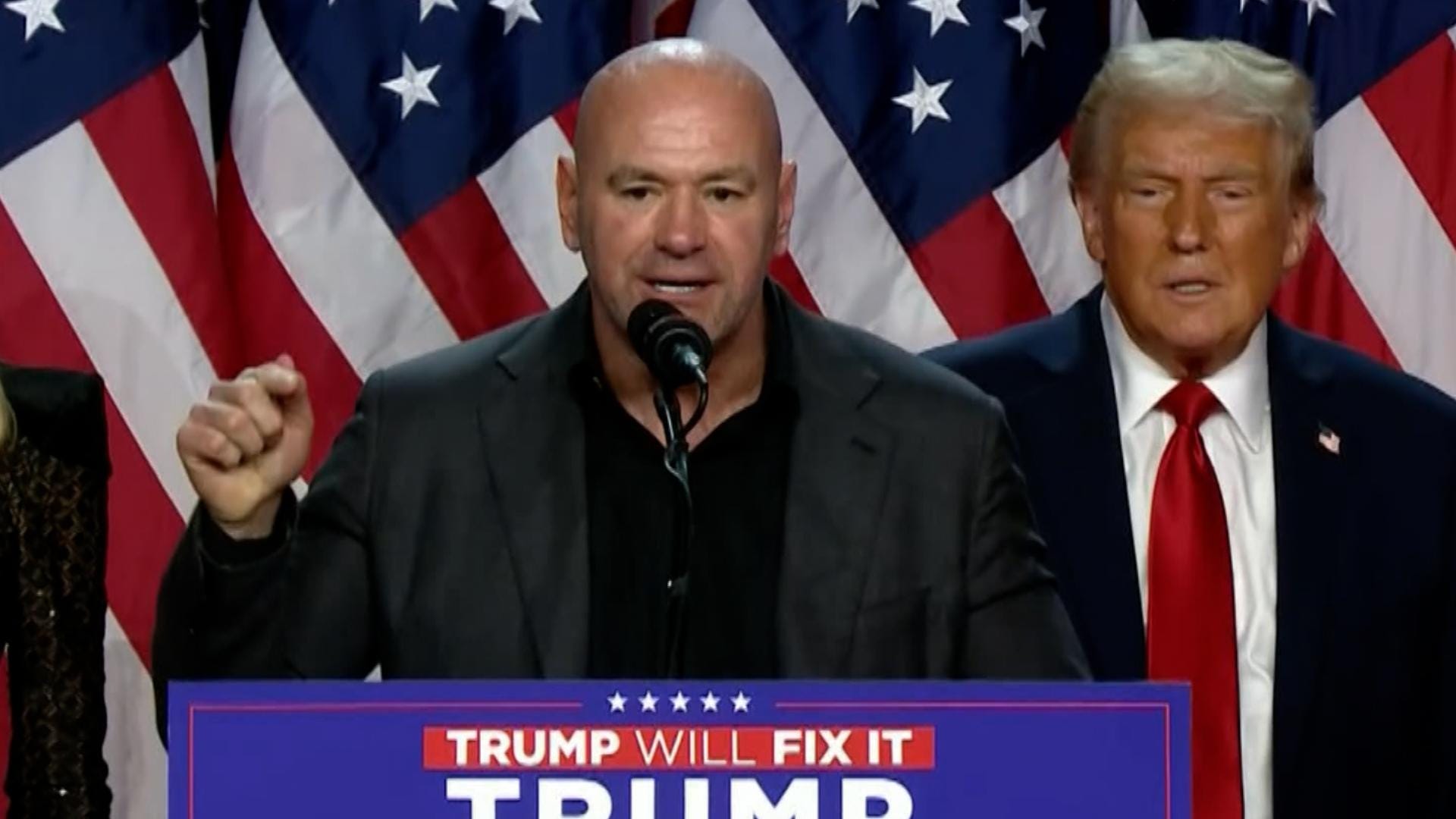
In the early hours of November 6th, while celebrating Donald Trump’s re-election, UFC’s CEO Dana White gave a chaotic victory speech in which he publicly acknowledged members of the manosphere, a sect of far-right influencers who have spent recent years luring young men toward authoritarian politics. The speech was widely viewed as a grim reminder of the ways in which the left has lost significant ground in the culture wars, prompting an already memetic repetition that the left “needs its own Joe Rogan.” But White’s presence in the Trump campaign has been indicative of much broader and more sinister cultural trends at play, reaching back much further in time than critics would like to admit. At its core, UFC, White’s $12-billion mixed martial arts promotion, has long been a breeding ground for fascist aesthetics since its debut in 1993, and its embrace in the mainstream, along with the more recent explosion of Youtuber boxing, is the logical endpoint of a culture that has been bending toward fascism for many years.
UFC’s culture is one of brute force. Imagined honor in violence. Within every contestant lies the urge to be a hero and the valiant rush to death, as Umberto Eco would have called it. Fights don’t end, even after they’re already won, as was the case when Khabib Nurmagomedov rained blows down on Conor McGregor’s training staff after submitting the Irishman in 2018. Humiliation is a key tenet of UFC’s culture. In mixed martial arts it is not enough to win by decision. One has to dominate his opponent, encouraged by the fact that White awards his fighters tens of thousands of dollars in extra prize money for especially violent finishes. UFC combatants often go so far as to reflect one of fascism’s main paradoxes: my opponent is weak and pathetic, they’ll argue at press conferences, but upon victory claim glory for having defeated such a strong rival.
Perhaps above all, however, one of the most obvious reflections of UFC’s propagation of fascist aesthetics is its relation to male body as a symbol of beauty—a near Riefenstahlian obsession with the classical figure. In his considerations of the fascist aesthetic, historian George Mosse once wrote that, “Every man must aspire to a classical standard of beauty, and as he built and sculptured his body (and we must remember the part played by physical exercise in the aesthetics of fascism), his mind would come to encompass all the manly virtues which the fascists prized so highly.” In combat sports, as in bodybuilding, particular focus is placed on the vascular, musclebound physiques of its combatants, who are deemed the pinnacle of a certain brand of masculinity. Joe Rogan, a longtime television commentator for the UFC brand, has helped emphasize this admiration for the male physique as a symbol for the ideal, proposing diets of elk meat and expressing fondness for pseudoscientific fat burners and for antivax ideology.
And just as the semiotics of UFC and its related entities have quietly carried the torch of authoritarianism, its messaging has become increasingly direct over time. Former UFC champion Sean Strickland has made frequent homophobic remarks on X/Twitter, ones that his boss Dana White has defended under the guise of free speech. Earlier this year, in a press conference for UFC 297, while wearing a t-shirt bearing the phrase, “A woman in every kitchen, a gun in every hand,” Strickland responded to a reporter’s question about his homophobic comments by asking, “Are you the fucking opposition?” When the reporter declined to answer, Strickland lashed out, calling the reporter—verbatim—“An infection, the definition of weakness,” and “the fucking enemy of the world.”
It would be easy to chalk up these kinds of outbursts and spectacles to brain damage, which Strickland no doubt suffers from (aside from being a professional fighter he was thrown from his motorcycle and nearly killed in an accident in 2018). But to do so would be to ignore the superstructure at play, the one that, as Mosse said, is “the means through which most people grasp the fascist message.” The Youtube clip of Strickland verbally assaulting a reporter is attached to hundreds of comments from viewers applauding the fighter’s message. “I love how supremely confident he is,” one commenter writes. “America NEEDS more men like this,” another says. White’s encouragement and dissemination of this mode of propaganda has helped cement UFC as a communication channel for American authoritarianism.
MMA as a whole built its bones on provocation. When it arrived on the scene, it begged the question: what if there were no rules? What if we could broadcast a street fight? Who would stop us? Is shutting us down not a violation of our rights? Does this trigger you? This type of provocation is shared as a central component of algorithm-based entertainments like Youtube. On Youtube, shocks get clicks. Antagonism gets clicks. In many cases this has led to Youtubers having beef with one another, eventually leading to full-fledged boxing cards, hosted in massive arenas. It was the inevitable nadir for an online cultural landscape in which disagreements are irreconcilable, disagreement is treason, and the only pathway to peace is through violence. And of course, no Youtube boxer has been a bigger provocateur and bigger star in the sport than Trump ally Jake Paul.
When Jake Paul enters the ring on Friday night against Mike Tyson he will be, for better or worse, the most popular boxer on the planet. He has gained more cultural cachet than Oleksandr Usyk, boxing’s actual heavyweight champion of the world, and his circus sideshows attract more viewers than any other championship boxing contest from recent memory. Should he defeat Tyson, as by all accounts he will, the popular perception will continue for the uninformed that Paul is a legitimate fighter. Anyone with sense would recognize this as a lie. The reality will be that he committed elder abuse against a man who nearly died from a bleeding ulcer in the lead-up to their originally scheduled fight date in July. But this will not matter. Paul’s inevitable slaying of Tyson will be a slaying of the past and a distortion of the present reality, because fascism is not concerned with reality, only with the civic religion of its own design—and Tyson, himself the ultimate symbol of late twentieth-century machismo and violence will have succumbed to a brash, child actor-turned-amateur boxer. Jake Paul can insist all he wants that his unsporting spectacles are just for entertainment, just as Dana White can. But entertainment does not exist in a vacuum. Entertainment exists as a byproduct of the culture that produces it, and a culture that would embrace UFC and influencer boxing is one whose very framework is comprised of an undemocratic devotion to unchecked anger, reactionary politics, and violence as supreme virtue.
The culture gets what the culture deserves.